Getting Started
What Is Microsoft Fabric? A Practical Overview
Understand how OneLake, workspaces, Lakehouses, Warehouses, notebooks, pipelines, SQL endpoints and semantic models fit together.
Planned · View in editorial roadmap →Guided learning path
Learn Microsoft Fabric by building
Start with a workspace and your first notebook, then progress through Lakehouses, Delta tables, Warehouses, Git, CI/CD and production-scale engineering.
01—12
Follow the core path from an empty workspace to a production-ready data workflow.
Getting Started
Understand how OneLake, workspaces, Lakehouses, Warehouses, notebooks, pipelines, SQL endpoints and semantic models fit together.
Planned · View in editorial roadmap →Getting Started
Create a development workspace with sensible capacity, access and ownership decisions from the start.
Planned · View in editorial roadmap →Your First Data
Build a Lakehouse and understand its Files, Tables and SQL analytics endpoint surfaces.
Planned · View in editorial roadmap →Your First Data
Use PySpark to load, inspect and summarize a dataset in your first Fabric notebook.
Planned · View in editorial roadmap →Play with Data
Practice the DataFrame operations used to explore and shape data in Fabric notebooks.
Planned · View in editorial roadmap →Play with Data
Query notebook data with Spark SQL and decide when SQL or PySpark is the clearer tool.
Planned · View in editorial roadmap →Play with Data
Persist a DataFrame as a managed Delta table and query it from Spark and SQL.
Planned · View in editorial roadmap →Learn how to structure raw, conformed and serving data layers without over-engineering the platform.
Foundations
What the Bronze, Silver and Gold layers are for, how data quality and incremental processing work across them in Microsoft Fabric, and when fewer layers are the better design.
Read tutorial →Foundations
A critical look at the Medallion pattern: when two layers or a single curated model are enough, and the cost that each unnecessary layer adds.
Planned · View in editorial roadmap →Layer design
How to design a Bronze layer that preserves source fidelity: landing formats, ingestion metadata, schema drift, retention and replay.
Planned · View in editorial roadmap →Layer design
How to turn source-shaped Bronze data into clean, validated, conformed Silver entities that several consumers can share.
Planned · View in editorial roadmap →Layer design
How to design the Gold layer that reports, semantic models and APIs consume: modelling choices, stable contracts, serving engines and how to change it without breaking consumers.
Planned · View in editorial roadmap →Engineering patterns
How changes propagate from Bronze to Silver to Gold without full reloads: change detection between layers, affected keys and recomputing only impacted aggregates.
Planned · View in editorial roadmap →Engineering patterns
Which write pattern belongs in which layer: append in Bronze, MERGE for Silver entities and history, and targeted overwrite or MERGE for Gold.
Planned · View in editorial roadmap →Engineering patterns
Why the right partitioning often differs by layer, from load-date partitions in Bronze to unpartitioned Gold tables, and how to decide.
Planned · View in editorial roadmap →Engineering patterns
Where small files come from in each layer and how to plan OPTIMIZE, V-Order and VACUUM per layer instead of applying one schedule everywhere.
Planned · View in editorial roadmap →Capstone
A complete, production-minded Medallion pipeline in Fabric: incremental ingestion, quality gates, MERGE, maintenance, logging and deployment. It builds on the first end-to-end pipeline tutorial.
Planned · View in editorial roadmap →Lakehouse & Warehouse
The criteria I use to choose between a Fabric Lakehouse and a Fabric Warehouse: team skills, write patterns, T-SQL needs and governance.
Planned · View in editorial roadmap →Build with Data
Move CSV or Parquet through a notebook-driven Bronze, Silver and Gold flow into a queryable serving layer.
Planned · View in editorial roadmap →Parameterized Notebooks
Pass dates and business identifiers from a pipeline into one reusable Fabric notebook.
Planned · View in editorial roadmap →Getting Started
Connect a Fabric workspace to a repository and understand branches, synchronization, versioned artifacts and current limitations.
Planned · View in editorial roadmap →Git & CI/CD
Use Fabric Git integration deliberately across branches, workspace artifacts and team workflows.
Planned · View in editorial roadmap →Git & CI/CD
How to promote Fabric items between environments: configuration per environment, data separation, approvals and rollback.
Planned · View in editorial roadmap →Git & CI/CD
A practical deployment approach for Fabric items using Git integration, deployment pipelines and automation, including what still needs manual steps.
Planned · View in editorial roadmap →Git & CI/CD
Separate deployable workspace artifacts from data, connections and environment-specific configuration.
Planned · View in editorial roadmap →Production Engineering
Design an execution log that makes notebook and pipeline runs traceable in production.
Planned · View in editorial roadmap →Production Engineering
Use a repeatable workflow to diagnose Spark, schema, parameter, dependency and pipeline failures.
Planned · View in editorial roadmap →Performance & Scale
Patterns for loading only new and changed data into Fabric, with watermarks, change tracking and Delta MERGE, and how to handle late or corrected data.
Planned · View in editorial roadmap →Performance & Scale
Build a practical baseline for file layout, Spark execution and Delta writes at multi-million-row scale.
Planned · View in editorial roadmap →Performance & Scale
Plan storage, partitioning, incremental processing and capacity for billion-row Fabric workloads.
Planned · View in editorial roadmap →Performance & Scale
Criteria for choosing a partition column: cardinality, query filters, write patterns and data volume per partition.
Planned · View in editorial roadmap →Performance & Scale
How file size affects read parallelism, metadata overhead and write cost, and how to pick a target size for your engines.
Planned · View in editorial roadmap →Performance & Scale
How Delta MERGE works internally and the patterns that keep it fast: narrowing the target, partition and file pruning, and source deduplication.
Planned · View in editorial roadmap →Performance & Scale
Where small files come from in Delta tables, how they slow down reads, writes and the transaction log, and how to measure the problem.
Planned · View in editorial roadmap →Performance & Scale
A step-by-step workflow for slow Fabric workloads: deciding whether the problem is capacity, Spark, SQL, storage layout or the query itself.
Planned · View in editorial roadmap →
Cloud & Automation
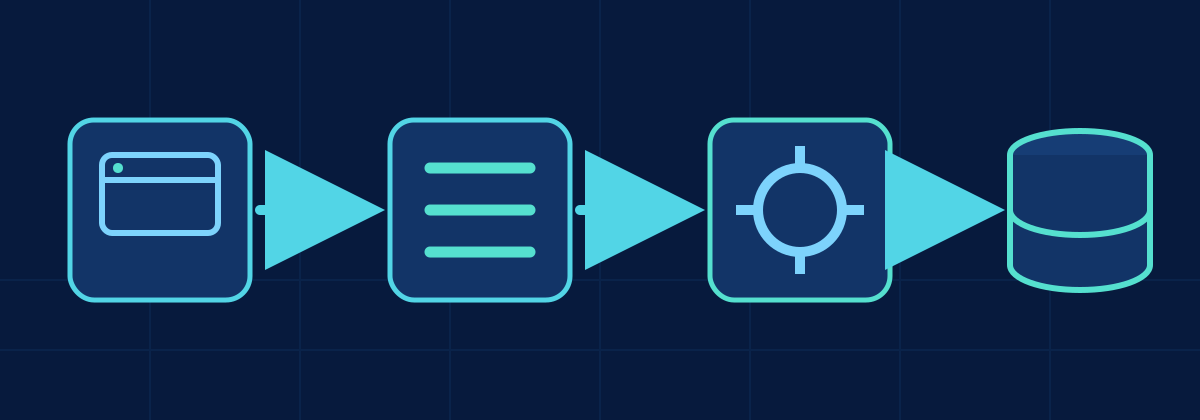
Trace a report request through gateway, security, validation, cache, Fabric query, result construction and monitoring.
Cloud & Automation
Define the report engine as a secure service between UI or API consumers and analytical data.
Microsoft Fabric
A practical workflow for reducing Fabric notebook startup, read, shuffle, transformation and Delta write time without guessing.
Certification
Connect the official DP-600 or DP-700 skills outline to hands-on Fabric projects, troubleshooting, and production practice.